
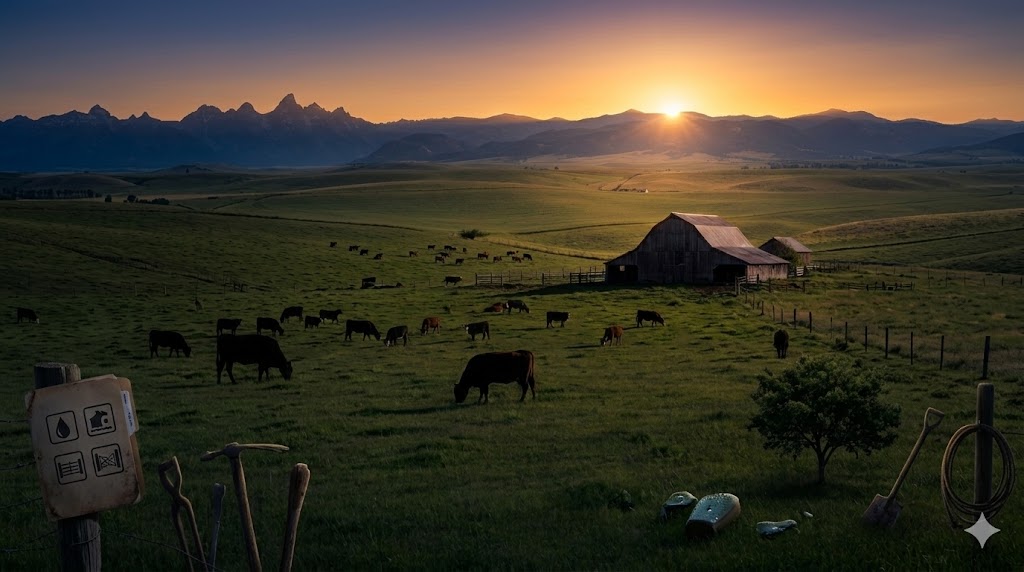
The 2026 Land & Ranch Market isn't going to be roaring, and it isn't going to be collapsing. It's just going to be… stuck. Not in a crisis-mode but more like two stubborn mules tied to opposite posts. Sellers anchored to yesteryear's prices. Buyers anchored to today's reality. Neither ready to budge.
Call it a "Stalemate Market". Call it "Nobody's Market". Call it whatever you'd like, either way, 2026 is shaping up to be a year where only the right properties move like; well-watered, functional, income-capable, and priced with both feet on the ground.
Land Sales: Flat, Quiet, and Selective
Vacant and recreational land isn't dead, but it's nowhere near energetic. Most of what sells right now is either:
- priced aggressively,
- has water or long-term potential, or
- fills a recreational niche for out-of-state buyers.
Everything else? Sitting. Not from lack of interest, but from lack of alignment. Buyers are patient, picky, and financially conservative. Sellers, meanwhile, are reluctant to adjust valuations after several years of inflated expectations.
This isn't a softening market. It's a stubborn one.
Ranch Sales: A Market Split by Price
The 2025 ranch sector was strange and the outlook points to that continuing into 2026.
Ranches priced $1M to $10M are a bit sluggish. Deals stall. Showings drag. Properties go on and off the market more than they go under contract. And this isn't unique to Wyoming -brokers in neighboring states are reporting the same pattern.
A perfect example:
- Thieves' Den Ranch, an 8,400+/- acre ranch south of Casper, sitting at $9.2M, still waiting for the right buyer.
- Its northern sister, Big Red Creek Ranch, a 10,000+/- acre ranch, at $7.2M, has a similar situation.
Meanwhile, on the opposite end of the spectrum:
- Pathfinder Ranch, listed at $79.5M, went under contract in roughly two months. (This ranch just recently closed.)
- Ultra-premium offerings across the West? Many moving faster than the mid-tier.
Then you have the outliers, like Wild Horse Basin Ranch, listed at $45M, on and off the market with different brokers over the last few years. Proof that prestige pricing alone doesn't create urgency. New offerings with clean narratives tend to move faster than "recycled" listings.
In short:
If a ranch is priced mid-tier, buyers may stall. If it's ultra-high-end and rare, buyers may strike.
Interest Rates: Relief on the Horizon, But No Stampede
A shift in Federal Reserve leadership could bring modest rate reductions early in 2026. A little breathing room would be welcome, but don't expect buyers to flood back in overnight. The psychological drag of two years of high rates doesn't unwind instantly.
Smart buyers will return sooner. Everyone else will trickle in later.
Technology: From Useful to Essential
Drone mapping, soil data, water modeling, and AI-optimized land plans aren't "added bonuses" anymore - they're the filter. Buyers skip properties that lack clear data, mapping, or documentation. Sellers who invest in modern analysis will outperform those who rely on the old "photos and a prayer" approach. Technology isn't replacing boots on the ground; it's making the boots smarter.
Buyers now walk into land and ranch purchases far more educated than they used to be. Data is everywhere, mapping tools are public, and AI is teaching people how to evaluate a property before they ever call an agent. Tech doesn't replace expertise, but it absolutely exposes lazy marketing.
In 2026, two trends stand out:
- Data-driven marketing becomes the baseline, not the premium.
- Technology - Virtual fencing finally hits Wyoming's radar.
Virtual fencing has been discussed for the last few years, but now it's showing up on real operations in Wyoming. The appeal is obvious-less maintenance, fewer wildlife issues, reduced damage, and flexible grazing strategies. Upfront costs are real, but long-term efficiency gains can be significant. Expect more conversations about virtual fencing, especially from younger operators and tech-forward ranchers.
Water & Irrigated Ground: The Backbone of Value
Nothing has changed here, except the stakes have risen.
- Senior water rights.
- Pivot-ready ground.
- Reliable wells.
- Grazing supported by dependable water.
These aren't perks-they're prerequisites.
If a ranch can raise cattle, horses, bison, sheep, or goats with minimal water insecurity, it stays on buyers' short lists. If it can't, it gets passed over, regardless of the view.
Generational Shifts: The Quiet Risk
Generational ranches continue to change hands-some by choice, some by circumstance. Estate-planning gaps, aging operators, and shifting family priorities are quietly pushing more acreage onto the market. Younger buyers stepping in look nothing like the ranchers of twenty years ago. They're more business-minded, more tech-literate, and far more open to diversified revenue streams.
But they're also running headfirst into a brutal math problem: higher operating costs, tighter margins, and rising barriers to entry. The uncomfortable truth is that if this trajectory holds for another two decades, the number of active, independent ranching families may shrink even more.
Lifestyle Ranches: Still Hot, but Not for Everyone
Demand remains strong for lifestyle ranches with:
- water,
- recreation,
- grazing potential, and
- income diversification.
Lifestyle ranches will still sell, but rarely to young ranch families. The buyer pool has shifted upward in wealth, not downward in age. What used to be the "Instagram dream ranch" is now firmly priced into a luxury tier where the younger generation simply can't compete. Ultra-wealthy buyers are increasingly competing with one another, not with the next generation of ag producers-and the cultural implications of that shift aren't small.
The very top of the lifestyle market stays alive.
The middle? It's wobbling.
Bottom Line for 2026
This year isn't going to be about momentum - it's going to be about positioning.
- Properties with water, function, income, or true uniqueness will move.
- Mid-tier ranches priced without sensitivity to current buyer psychology will stall.
- Land will sell, but only when buyers and sellers find rare middle ground.
- Technology will creep deeper into ranch decision-making.
- The generational squeeze will intensify, reshaping who buys, sells, and stays in the game.
2026 may be defined by caution, calibration, and calculated moves. Not necessarily a boom. Not necessarily a bust. Just a stalemate - broken only by the properties that genuinely deserve attention.
"Expertise isn't dying… the performance of expertise is. Real knowledge is finally separating from the noise..."
If you want the real read on what 2026 means for your land or ranch—whether you’re buying, selling, or just trying to make sense of the stalemate—reach out. The market may be stuck, but your strategy doesn’t have to be.